

Fix & Flip Strategy
The “easy margin” era is gone — but fix & flip is still very profitable when you underwrite like the market is going to fight back. This guide breaks down the trends that are shaping flip profitability right now and gives you practical underwriting moves you can use on every deal.
The goal isn’t to predict the market. It’s to build a deal that still works if: rates stay high, DOM stretches, rehab costs climb, or you need a price cut to sell.
Market snapshot: what impacts flip profits the fastest
Fix & flip profitability is driven by the spread between (purchase + rehab + holding + selling costs) and what buyers will pay. In a tighter market, four trends move that spread more than anything else:
1
Rate sensitivity
Higher payments reduce the buyer pool and increase negotiation.
2
Competition
More listings (or new builds) force sharper pricing and better execution.
3
DOM pressure
Longer time to sell increases holding costs and drives price cuts.
4
Rehab volatility
Labor, permits, and material changes stretch budgets and timelines.
Trend-proof rule: If your deal only works with a best-case timeline and top-of-range ARV, it’s not a deal — it’s a bet.
Trend #1: Interest rates & buyer demand
Your exit depends on the end buyer’s payment. When rates stay elevated, buyers become more price-sensitive. That typically shows up as slower showings, more concessions, or price reductions.
What you’ll see in the field
- More negotiation even on clean, renovated homes
- Buyers comparing payment options, not just price
- Increased importance of “move-in-ready” simplicity
- More appraisal sensitivity in tight comp sets
Underwriting adjustment
- Run a DOM buffer (+30 to +60 days)
- Underwrite a price-drop scenario (2–4%)
- Favor buyer-friendly layouts vs “over-upgrading”
- Target margin that can survive friction
Reality: A flip that sells in 10 days at slightly lower profit can beat a “bigger profit” flip that sits for 90 days.
Trend #2: Inventory, new builds & competition
The market you’re selling into is local. Your real competition isn’t national headlines — it’s the active listings and new construction a buyer is touring this week. If inventory rises in your micro-area, you need sharper pricing and cleaner execution.
Comp discipline: Pull 3–6 sold renovated comps and 3–6 active renovated comps. Underwrite off the range — not the best one.
When inventory is tight
- Good flips move faster if priced correctly
- Fewer alternatives = less buyer leverage
- Small finish upgrades can stand out
When inventory rises
- More options = slower decisions
- Price reductions become common
- Functionality beats luxury upgrades
Trend #3: Days on market (DOM) & pricing resistance
Longer DOM is the quiet killer. Every extra week adds holding costs — and once a listing goes stale, you usually have to cut price to restart demand. The best flippers plan for DOM friction before they buy.
A simple DOM framework
- Base DOM: average DOM for renovated comps
- Buffer: +30 days (stable) or +45–60 (choppy/seasonal)
- Plan B list price: underwrite 2–4% lower
- Trigger: “no activity by X days → reduce by Y%”
Holding cost reminder
Time isn’t just interest. It’s taxes, insurance, utilities, HOA, lawn, and the opportunity cost of your next deal.
Trend-proof move: If +60 days kills your profit, renegotiate or pass.
Trend #4: Rehab costs & timeline risk
In today’s market, timeline risk can be just as damaging as budget risk. Labor availability, permit cycles, and “surprise” repairs stretch projects longer than planned — and you feel it in holding costs and price reductions.
Common cost/timeline pressures
- Labor scheduling gaps
- Permit/inspection delays (market dependent)
- Material lead times and substitutions
- Scope creep from hidden damage
How investors protect margins
- Contingency: 10–15% light | 15–20% heavy
- Phase planning: group work into draw-friendly milestones
- Scope clarity: line-item, room-by-room, photo supported
- Finish discipline: match the neighborhood buyer
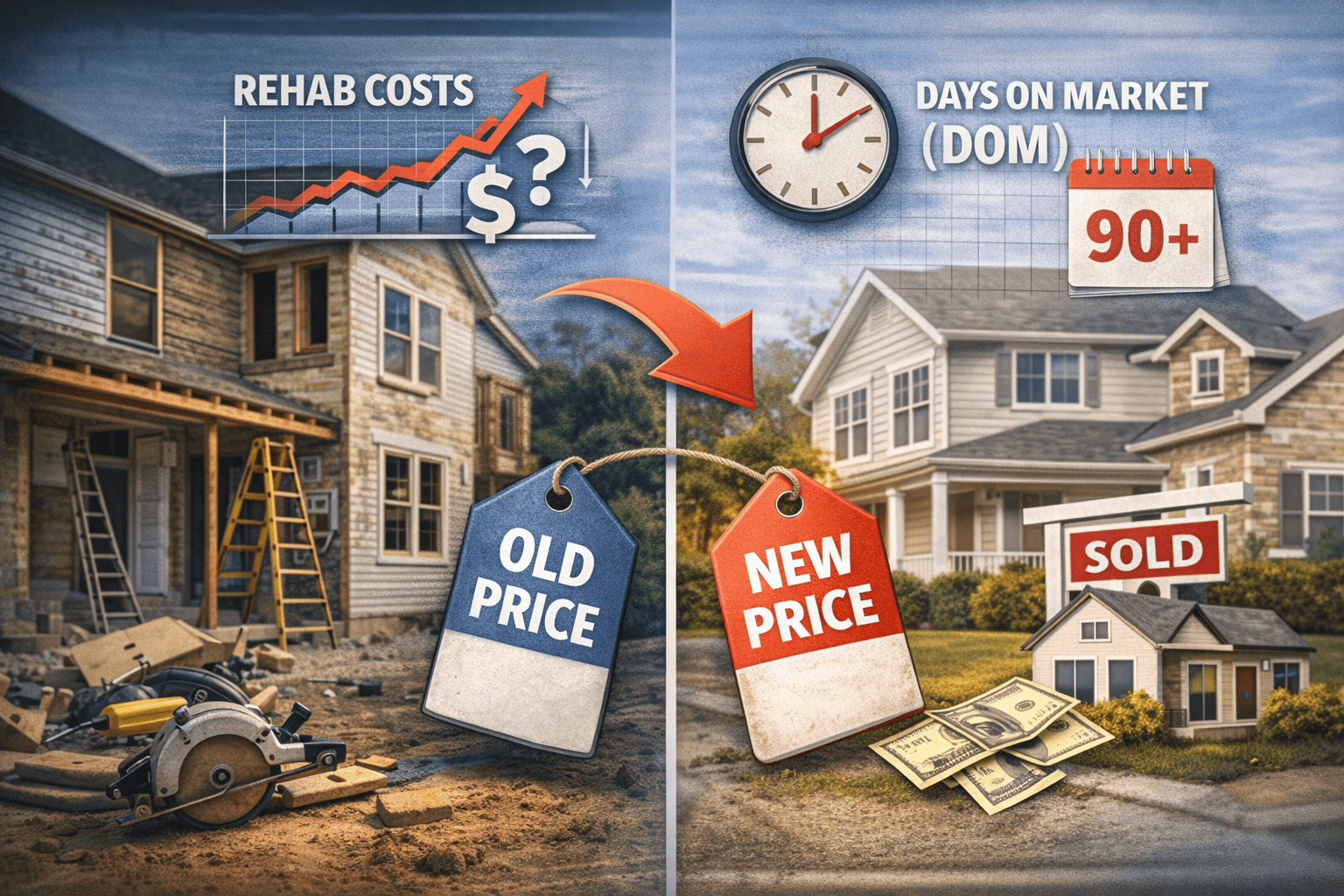
Don’t confuse “nice finishes” with “higher ARV.” If your comp set won’t support it, your upgrades won’t either.
How to underwrite flips right now (trend-proof approach)
Great flips are engineered. Here’s the underwriting structure we recommend when the market is less forgiving.
1
ARV as a range
Use low/mid/high. Base your offer on mid (or low in choppy pockets).
2
DOM buffer baked in
Add +30–60 days and confirm you still have margin.
3
Contingency reserved
10–20% depending on scope. If it’s tight, it’s risky.
4
Price-drop plan
Define triggers before emotions kick in.
5
Exit options
Primary exit + backup exit if it makes sense for the deal.
6
Clean deal package
Scope + comps + timeline + budget = faster underwriting.
Want to pressure-test a deal fast?
Run purchase + rehab + holding + selling costs and see the profit margin before you commit.
Deal playbook (copy/paste checklist)
Use this checklist on every offer. It’s designed to help you underwrite a deal that still works when the market adds friction.
- Comp set: sold + active renovated comps (same micro-area)
- ARV range: low/mid/high and your “base ARV” assumption
- DOM buffer: +30–60 days vs average renovated DOM
- Rehab scope: line-item + photos + finish level
- Contingency: 10–20% depending on complexity
- Holding costs: interest, taxes, insurance, utilities, HOA, lawn
- Selling costs: commissions + closing + concessions + staging
- Price-drop plan: trigger day + reduction %
- Exit plan: sell + backup option (only if realistic)
Want a second set of eyes? Run the numbers first, then reach out or apply when ready.
Fix & flip market trend FAQs
Are fix & flips still profitable in today’s market?
They can be — but the market is less forgiving. The flips that win are underwritten with buffers (DOM, contingency, and price-drop planning) and scoped to match what local buyers pay for.
What’s the biggest risk impacting flips right now?
Time + price reductions. Longer DOM compounds holding costs, and stale listings often need a price cut to restart demand — which hits profit twice.
How should I adjust my offer when DOM is rising?
Underwrite ARV as a range, add a DOM buffer, and run a 2–4% price-drop scenario. If profit doesn’t clear, renegotiate purchase price or pass.
Should I upgrade more to compete?
Only if comps support it. Most markets reward clean, functional, move-in-ready more than luxury upgrades that over-improve for the neighborhood.
How much contingency should I carry?
Many investors use 10–15% for light/moderate rehabs and 15–20% for heavier scopes. If your deal needs a tiny contingency to work, it’s tight for today’s market.
Have a deal you want to run by us? If you’re not ready to apply yet, you can still reach out with questions anytime. Contact us here →