

South Carolina Fix & Flip Guide
The fix-and-flip market in South Carolina moves fast—especially in Greenville, Charleston, Myrtle Beach, and Columbia. When you’re competing for deals, a traditional mortgage can be too slow and too restrictive. A fix & flip loan is built for investors who need speed, flexibility, and financing based on the property’s profit potential (not your W-2).
This guide walks you through requirements, ARV rules, typical rates/costs, draw schedules, and exit strategies— so you can move confidently from contract to closing.
Typical close time
7–14 Days
Deal-speed advantage
Underwriting focus
ARV
Value + scope
Common leverage
65–75%
Of after-repair value
Fast rule of thumb
If the ARV supports the loan and the scope of work is clear, fix & flip funding can be a strong fit— even if you’re self-employed or your tax returns don’t tell the whole story.
What is a fix & flip loan?
A fix & flip loan is a short-term real estate investment loan designed to fund the purchase and renovation of a property you plan to resell for profit. Instead of underwriting you like a traditional mortgage, lenders look closely at the property’s current condition, renovation plan, and after-repair value (ARV).
What it can cover
Many fix & flip loans can finance the purchase and a portion of the rehab budget, with renovation funds typically released in draws.
Why it’s different
Approval is driven more by deal strength than personal income. Your scope of work and ARV matter a lot.
Important clarification
Fix & flip loans are built for investment properties—not owner-occupied homes. Exact guidelines vary by lender, property type, and project profile.
Why investors use fix & flip loans in South Carolina
In competitive markets, speed wins. Fix & flip loans are designed to help investors close fast, execute renovations efficiently, and resell without being boxed into traditional mortgage rules.
Common investor advantages
- Faster closings: often faster than conventional financing for distressed properties.
- Deal-focused approval: underwriting looks at ARV and scope—not just income documentation.
- Rehab funding: renovation money can be included and released in draws as work is completed.
- More property flexibility: works well for outdated or distressed homes that banks avoid.
- Exit flexibility: sell after rehab or refinance into a rental/DSCR loan (scenario dependent).
Key fix & flip loan requirements in South Carolina
Requirements vary, but most fix & flip approvals come down to five core buckets: property eligibility, ARV, credit, cash contribution, and scope of work.
1) Property eligibility
Fix & flip loans are for non-owner-occupied investment properties. Common types include single-family homes, condos, townhomes, and 2–4 units.
Some lenders allow 5+ units through commercial programs.
2) Property condition
The property should justify the renovation plan and resale potential. Lenders want to see a clear “before → after” path.
3) Credit (typical guideline)
Many lenders look for around ~660+, with pricing improving as scores rise. Deal strength still matters.
4) Cash contribution
Down payment expectations often land around 10%–20% depending on the deal, experience, and leverage.
Some scenarios may allow lower—deal-dependent.
Experience helps (but it’s not always required)
Prior flips can improve leverage and pricing. If you’re newer, a strong contractor, clean scope, and conservative ARV assumptions make approvals smoother.
Purchase price + ARV rules (what lenders actually finance)
Fix & flip loans aren’t based only on today’s value—they’re often structured around the after-repair value (ARV), which is what the property is expected to be worth once renovations are complete.
Quick ARV concept
ARV = estimated resale value after repairs
Max loan often targets ~65%–75% of ARV (deal-dependent)
How ARV is verified
Many lenders use an appraisal or valuation that considers the scope of work and comparable renovated sales. Conservative ARV assumptions reduce surprises and conditions.
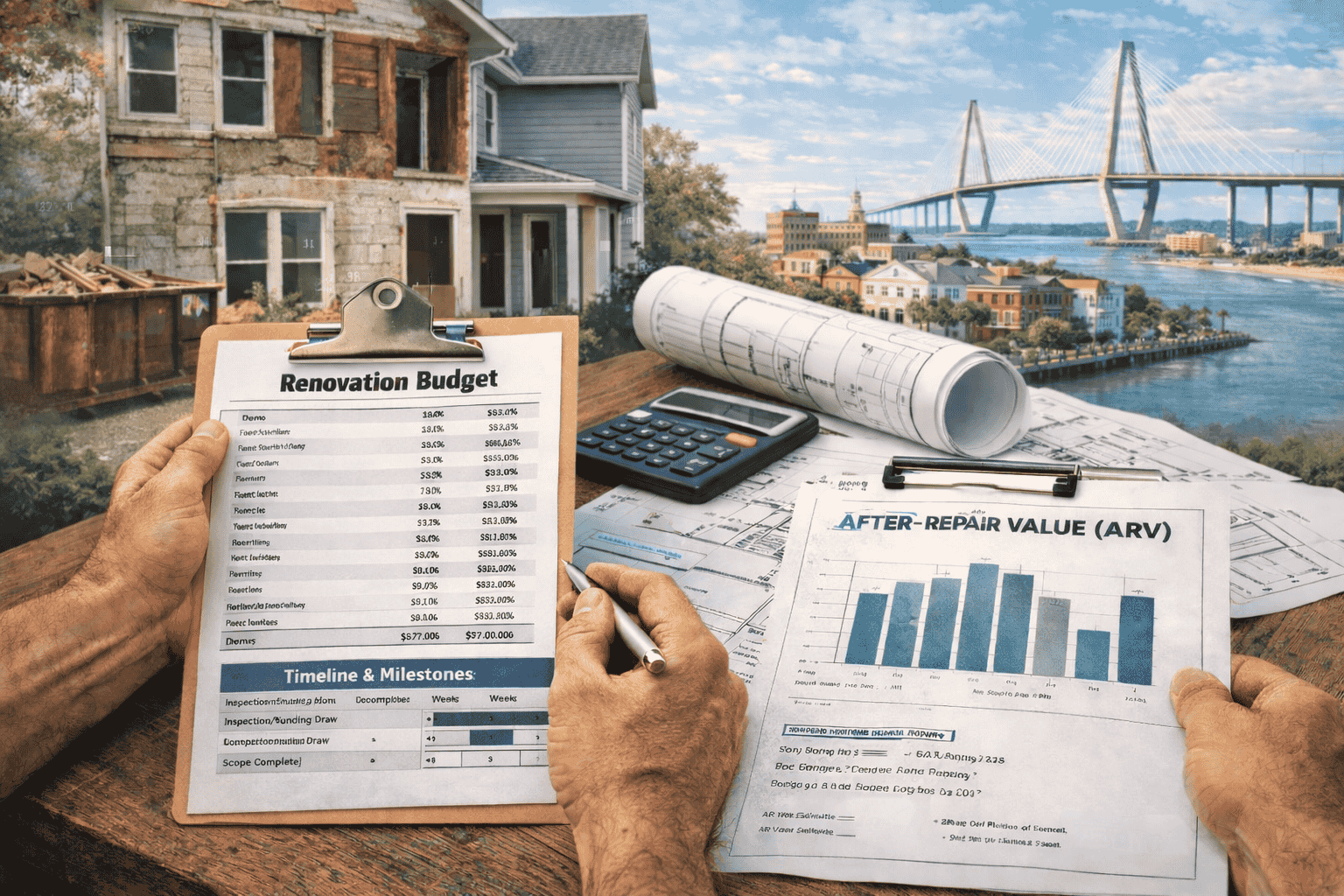
Renovation budget, scope of work, and draw schedules
The renovation plan is one of the biggest approval drivers. Lenders want a detailed scope and a realistic budget—not vague estimates.
- Line-item budget: materials + labor per trade (roof, HVAC, plumbing, flooring, kitchens, baths).
- Timeline and milestones: what happens when, and how long each phase takes.
- Draw process: rehab funds are commonly released after inspections confirm completed work.
- Contingency planning: older homes create surprises—buffer matters.
What slows down draws
Missing invoices, unclear milestones, or scope changes without documentation can slow inspections and funding. Keeping your scope tight helps the project move faster.
Exit strategy options: what lenders expect
Lenders want to see a clear exit plan. Most fix & flip exits fall into two buckets: sell after renovation or refinance into a long-term rental loan.
1) Resale after renovation
The classic flip: renovate, list, and sell. Your profit depends on ARV accuracy, rehab execution, and timeline control.
2) Refinance into a DSCR loan
If you decide to keep the property as a rental, refinancing into a DSCR loan may be an option based on rental cash flow and equity (scenario dependent).
Loan terms, rates, and costs for fix & flip loans in South Carolina
Fix & flip loans are short-term by design, so rates are typically higher than conventional mortgages. Pricing depends on deal strength, leverage, credit, experience, and the property profile.
Common term
6–12 months
Up to ~18 months in some cases
Rate range (typical)
~8%–14%
Scenario-dependent
Total costs
~2%–6%
Includes lender + third-party
Cost components you’ll usually see
Origination, appraisal/valuation, title/attorney closing (SC is an attorney-closing state), recording fees, and inspections for rehab draws.
Investor tip: protect your timeline
The fastest flips are usually the ones with a clean scope and realistic draw milestones. If speed matters, lead with a complete package.
When a fix & flip loan makes sense
Fix & flip financing is best when you’re buying a property that needs work—and you want the speed to compete. Because it’s short-term, it works best when your timeline is controlled.
Green-light scenarios
- Distressed or outdated home: property needs renovation to reach market value.
- Fast close needed: you’re competing against cash or aggressive investors.
- Clear rehab plan: scope and budget are defined, and contractor availability is real.
- ARV has room: spread supports costs, holding time, and resale strategy.
- Exit is realistic: you can resell or refinance within the loan term.
Fix & flip loan application process in South Carolina
The fastest approvals happen when the lender gets the full deal picture up front: address, purchase price, rehab budget, ARV, timeline, and your exit plan.
- 1Submit deal basics. Address, purchase, rehab budget, estimated ARV, and exit plan.
- 2Validate ARV. Appraisal/valuation supports comps and scope of work.
- 3Approve scope + draw plan. Lender confirms budget and milestones.
- 4Get terms. Rate, points, leverage, and closing requirements are issued.
- 5Close with attorney/title. Many deals close in ~7–14 days with a clean package.
- 6Renovate + draw. Inspections confirm progress before rehab funds are released.
Frequently asked questions
What credit score is needed for a fix & flip loan in South Carolina?
Many lenders look for around ~660+, but deal strength and ARV can matter more. Higher scores often improve pricing.
How much do lenders finance on fix & flip projects?
Many programs target roughly 65%–75% of ARV (deal-dependent), with rehab funds commonly released via draws.
Can first-time investors get fix & flip loans?
Yes. Experience can help, but newer investors can still qualify with a strong scope, conservative ARV, and a solid plan.
How fast can fix & flip loans close in South Carolina?
Many deals close in 7–14 days when valuation and documentation move quickly.
Do fix & flip lenders require income verification?
These loans are typically deal-focused (ARV + scope). Requirements vary, but personal income is often not the main driver like a traditional mortgage.
Bottom line
If you’re trying to take advantage of South Carolina’s fast-moving market, fix & flip financing can help you close quicker and execute renovations without the friction of a traditional mortgage.
The easiest way to get clarity is to run the deal: purchase price, rehab budget, ARV, and timeline. We’ll tell you what leverage is realistic and what the fastest path looks like.
Disclaimer: This content is for educational purposes and doesn’t constitute financial, legal, or tax advice. Program guidelines and pricing can change and vary by scenario.