
Your home is more than a place to live — it’s one of your biggest financial assets. As you pay down your mortgage and your property value rises, you build equity that can help you reach other goals. Two of the most common ways to access that equity are a Home Equity Loan and a Home Equity Line of Credit (HELOC). They both use your home’s value, but they work very differently.
This guide breaks down how each option works, their key differences, pros and cons, and when each one makes the most sense.
What Is a Home Equity Loan?
A home equity loan gives you a one-time lump sum that you repay at a fixed interest rate over a set term. Think of it like a second mortgage that sits beside your primary mortgage. Because the rate and term are set, your monthly principal and interest payment stays the same for the life of the loan.
Key Features
- One-time payout: Receive the full amount at closing.
- Fixed interest rate: Your rate doesn’t change with the market.
- Predictable payment: Same monthly payment for 10, 15, or 20 years (typical terms).
Best For
Large, clearly priced one-time expenses — e.g., a major remodel, consolidating high-interest debt, or big life expenses with a defined cost.
What Is a HELOC (Home Equity Line of Credit)?
A HELOC works like a revolving credit line secured by your home. Instead of a lump sum, you can borrow what you need, when you need it, up to your limit during the draw period (often up to 10 years). Many HELOCs allow interest-only payments during the draw period, helping keep initial payments lower. After the draw period, you enter repayment and pay back principal and interest.
Key Features
- Flexible access: Draw, repay, and draw again during the draw period.
- Variable interest rate: Typically tied to a market index (e.g., Prime).
- Lower early payments: Interest-only options during draw are common.
Best For
Costs spread out over time — e.g., phased renovations, ongoing tuition, unexpected repairs, or as a ready cash buffer.
Key Differences Between a HELOC and a Home Equity Loan
The biggest differences are how you access funds and how you repay them.
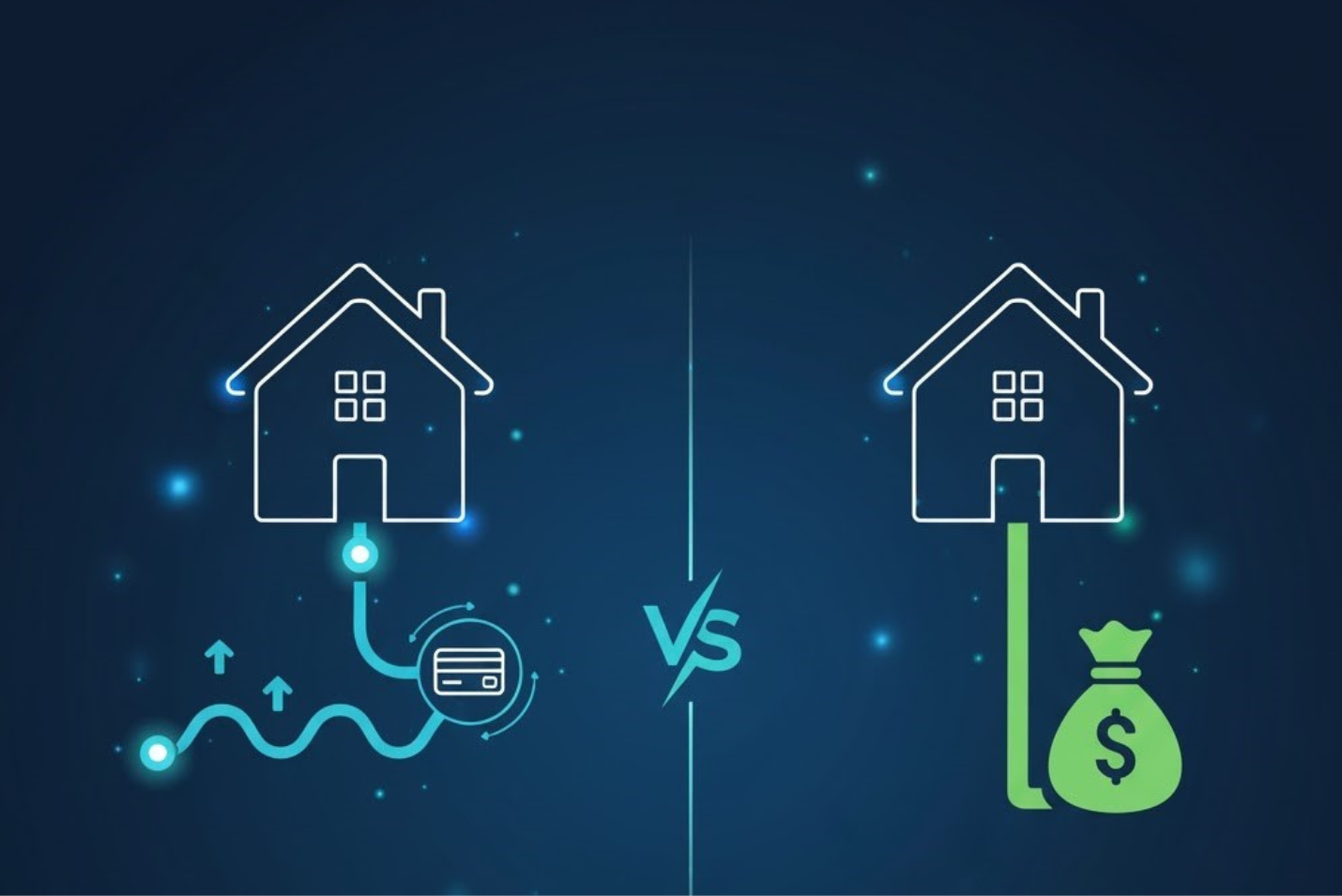
| Feature | Home Equity Loan | HELOC |
|---|---|---|
| How You Receive Funds | Lump sum at closing | Draw as needed during draw period |
| Interest Rate | Fixed | Variable (index + margin) |
| Payments During First Phase | Fixed principal & interest | Often interest-only (during draw) |
| Repayment | Fixed for the term (e.g., 10–20 yrs) | After draw, repay principal + interest (e.g., 10–20 yrs) |
| Best For | One-time, known costs | Ongoing or uncertain costs |
| Primary Risk | Fixed payment may feel heavy if income changes | Payments can rise if rates increase; easy to over-borrow |
Pros and Cons of Each Option
Home Equity Loan — Advantages
- Predictability: Fixed rate and fixed payment are easy to budget.
- Rate protection: Rising market rates won’t change your payment.
- Great for set projects: Works well when you know the exact cost.
HELOC — Advantages
- Flexibility: Borrow only what you need, when you need it.
- Lower initial cost: Interest-only options during draw can keep early payments down.
- Reusable: As you repay principal, funds become available again during draw.
When to Choose Each
Choose a Home Equity Loan if:
- You want a fixed payment and fixed rate.
- You have a single, well-defined cost (e.g., $40k kitchen remodel).
- You prefer the certainty of a traditional amortizing loan.
Choose a HELOC if:
- You expect expenses to come in phases or to change over time.
- You want the option of interest-only payments during the draw period.
- You’d like an on-demand cash buffer without reapplying.
How to Apply with VP Capital Lending
Getting started is simple. We’ll talk through your goals, review your equity, and map the option that fits best. In general, lenders look for:
- Home Equity: Typically at least 15%–20% equity (verified by a current valuation).
- Credit Score: 640+ usually works; higher scores can qualify for better rates.
- Debt-to-Income (DTI): Aim for 50% or less.
Common Questions About HELOCs and Home Equity Loans
Is a HELOC or a home equity loan better?
It depends on your goals. A home equity loan is often better for one-time, fixed-cost projects because of the predictable payment. A HELOC is often better for ongoing or uncertain costs because you can draw funds as needed.
Can I have both a HELOC and a home equity loan?
Yes, it’s possible if you qualify and have enough available equity. Many homeowners choose one based on their long-term plans and budget preferences.
How long does approval take?
It varies, but expect a few weeks or more. You’ll complete an application, provide documentation, and your home’s value will be reviewed as part of the process.
Does VP Capital Lending offer both?
Yes — we offer both HELOCs and home equity loans for qualified homeowners.
Final Thoughts
If you want stability and a set payment for a single project, a home equity loan is a strong choice. If you prefer flexibility and on-demand access to funds for evolving costs, a HELOC can be a better fit. Not sure which route to take? We’ll help you compare scenarios and choose with confidence.